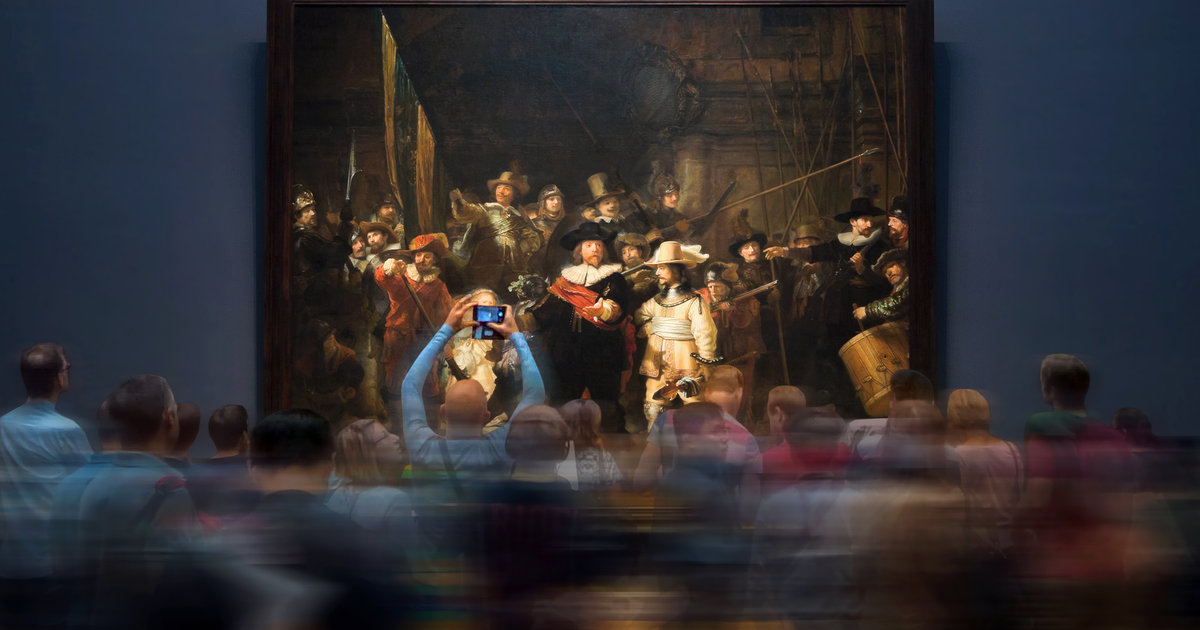
Rijksmuseum's Breakthrough: 'Vision of Zacharias' Confirmed as Rembrandt
The art world is abuzz with a wave of exciting discoveries, and at the forefront of this renaissance is the prestigious Rijksmuseum in Amsterdam. In a landmark announcement, art experts at the museum have definitively attributed the painting 'Vision of Zacharias in the Temple' to the Dutch Golden Age master, Rembrandt van Rijn. This confirmation adds a significant early work from 1633 to the artist's esteemed oeuvre, sparking renewed global interest in one of history's most celebrated painters.
The discovery, made possible through a combination of cutting-edge scanner technology and meticulous stylistic analysis, underscores a broader trend: the continuous unveiling of long-lost or previously misattributed masterpieces. This particular *wiederentdeckter Rembrandt*, or re-discovered Rembrandt, represents a triumph of modern art scholarship and technological innovation, allowing us to delve deeper into the genius of a painter whose influence remains immeasurable.
A Masterpiece Unveiled: The Rijksmuseum's Triumph
The 'Vision of Zacharias in the Temple' has long been a subject of scholarly debate, its true authorship shrouded in uncertainty. Dating back to 1633, the painting captures a pivotal moment from the biblical narrative, showcasing Rembrandt's early mastery of dramatic light and emotional depth. The Rijksmuseum's team embarked on an intensive research project, leveraging state-of-the-art analytical tools to scrutinize every layer of the artwork.
Their findings revealed undeniable proof: the characteristic brushwork, the intricate layering of pigments, and the compositional choices align perfectly with Rembrandt's known techniques from that period. The painting will now take its rightful place as a long-term loan at the Rijksmuseum, offering the public a rare opportunity to witness an early work by the master, providing crucial insights into his artistic development during his formative years in Amsterdam. This addition enriches the museum's already unparalleled collection of Dutch Golden Age art and further cements its status as a global hub for Rembrandt studies.
The Science of Authentication: Proving a Rembrandt
The confirmation of 'Vision of Zacharias' as an authentic Rembrandt highlights a profound shift in the methods of art authentication. Historically, the attribution of Old Master paintings often hinged on the subjective judgment of a few venerated experts, whose pronouncements carried an almost "papal infallibility." The passing of Professor Ernst van de Wetering in 2021, a figure whose expertise on Rembrandt was considered definitive, marked a turning point. Today, the process relies less on individual opinion and more on a multidisciplinary, scientific approach.
The Rijksmuseum's breakthrough, much like other recent Rembrandt discoveries, involved an extensive journey of research and authentication. Advanced scanner technology, including X-ray and infrared reflectography, played a crucial role. These techniques allow art historians to peer beneath the surface layers of paint, revealing underdrawings, compositional changes (pentimenti), and the unique hand of the artist. For instance, in the case of another significant *wiederentdeckter Rembrandt* – a late work depicting Rembrandt's son Titus, recently confirmed by Sotheby's – detailed analysis of brushstrokes in the drapery was compared to known works, such as the portrait of Hendrickje Stoffels in Frankfurt's Städel Museum.
A vital aspect of these technical investigations involves collaboration among institutions. Petria Noble, the Chief Conservator at the Rijksmuseum, for example, was instrumental in technical examinations of the Sotheby's Titus painting. This inter-institutional cooperation, combining the expertise of conservators, art historians, and scientists, creates a robust framework for authentication, ensuring that attributions are based on empirical evidence rather than conjecture. It's a meticulous process that leaves no doubt, as confirmed by experts like George Gordon of Sotheby's, who stated, "We have had a long journey of research. Now there is no doubt."
Beyond Zacharias: A Resurgence of Rembrandt Discoveries
The Rijksmuseum's announcement is not an isolated incident but rather part of a thrilling period for Rembrandt scholars and enthusiasts. The art market is experiencing a true "Rembrandt fireworks," with multiple significant discoveries and auctions planned. Beyond the 'Vision of Zacharias,' other notable *wiederentdeckter Rembrandt* paintings have recently captured headlines:
* **The Sotheby's Titus Portrait:** This exceptional late work, dating to around 1660 and depicting Rembrandt's son Titus, resurfaced after being lost for approximately a century. Its journey from an obscure existence (known only through a faded black-and-white photograph) to a confirmed masterpiece involved a year-long "secret operation" by Sotheby's Old Masters specialist George Gordon. This remarkable find is slated for auction, highlighting the enduring allure of the master's personal life translated onto canvas. For a deeper dive into this incredible tale, read
The Long-Lost Rembrandt: Sotheby's Unveils a Century-Old Mystery.
* **Christie's Portrait Pair:** In another exciting development, experts at Christie's stumbled upon a small pair of portraits by Rembrandt during a routine house inventory assessment. Painted in 1635, these depict relatives of the artist, offering a charming glimpse into his personal circle and early portraiture style. Discoveries like these often emerge from private collections, underscoring that many artistic treasures still await rediscovery in unexpected places.
These cumulative findings underscore a fascinating phenomenon: despite centuries of scholarship, Rembrandt's body of work continues to surprise and expand. This ongoing process enriches our understanding of his techniques, subjects, and periods of activity. To track more of these remarkable finds and upcoming auctions, explore
New Rembrandts Emerge: Tracking Recent Masterpiece Discoveries & Auctions.
The Art Market Buzz: Valuing a Rediscovered Masterpiece
The confirmation of a *wiederentdeckter Rembrandt* invariably sends ripples through the global art market. While a newly attributed Rembrandt is always a sensation, it's important to understand the dynamics that influence its market value. While one might expect record-breaking prices for such finds, this isn't always the case. Factors such as condition, subject matter, size, and the specific period of the artist's career can all play a role. For instance, the Sotheby's Titus painting, despite its profound significance, might not achieve the highest record prices often associated with pristine, iconic works due to its status as a recent attribution and its somewhat raw, expressive late-period style.
For art collectors and investors, these discoveries present both opportunities and challenges.
- Provenance is Key: While new attributions are exciting, a strong, unbroken provenance (history of ownership) often adds significant value and reduces risk.
- Embrace Scientific Analysis: Modern authentication methods provide unparalleled certainty. Collectors should seek out artworks that have undergone rigorous technical examination.
- Understand the Context: The significance of a *wiederentdeckter Rembrandt* extends beyond its monetary value. It contributes to art history, offering fresh perspectives on the master's genius. Investing in such a piece is also an investment in cultural heritage.
- Seek Expert Consensus: While individual expert opinions are valuable, a consensus among a broader group of scholars and institutions provides the strongest validation.
The current environment for Rembrandt, with prints, drawings, and paintings all making headlines, indicates robust interest. However, the true value of these *wiederentdeckter Rembrandt* paintings lies not just in their auction potential, but in their capacity to redefine our perception of one of history's most compelling artists.
Conclusion: Rembrandt's Enduring Legacy
The Rijksmuseum's confirmation of the 'Vision of Zacharias' as an authentic Rembrandt marks a monumental achievement in art scholarship and continues the thrilling narrative of rediscovery surrounding the Dutch master. Alongside the resurfacing of the Titus portrait and other minor works, these findings paint a vibrant picture of an art world where cutting-edge technology and dedicated expertise are continually unearthing treasures from the past. Each *wiederentdeckter Rembrandt* not only adds a new jewel to his artistic crown but also provides invaluable insights into his creative process, his life, and the rich tapestry of the Dutch Golden Age. As these masterpieces are brought to light, they remind us that the legacy of artists like Rembrandt is not static, but a dynamic, evolving story, waiting to be further explored and appreciated by generations to come.